
Red Devils' Ledger: Decoding Manchester United's Financial Scorecard Amidst Minority Interest Funding Prospects
Unlocking New Horizons: Manchester United's Financial Conundrum and the Quest for Strategic Investment

In the hallowed halls of Old Trafford, where the echoes of glory reverberate through the ages, another crucial chapter unfolds—one that delves into the financial tapestry of Manchester United. As passionate fans fill the stands, the balance sheets and income statements tell a tale of fiscal strategies and potential game-changing manoeuvres.
As we embark on this financial expedition, the spotlight is on more than just numbers; it's on the imminent minority interest funding that could reshape Manchester United's financial landscape. Beyond the goals and victories, the club is navigating a complex field of financial decisions, and understanding these dynamics is paramount to unraveling the complete narrative.
In this article we dissect the financial intricacies of one of football's most iconic institutions. From revenue streams to minority interest funding, we'll explore the numbers that underscore Manchester United's financial performance and the strategic moves that may shape the future of the Red Devils on and off the pitch. The game is not just about goals; it's about the financial playbook that propels one of football's giants forward.
Manchester United Revenue Growth
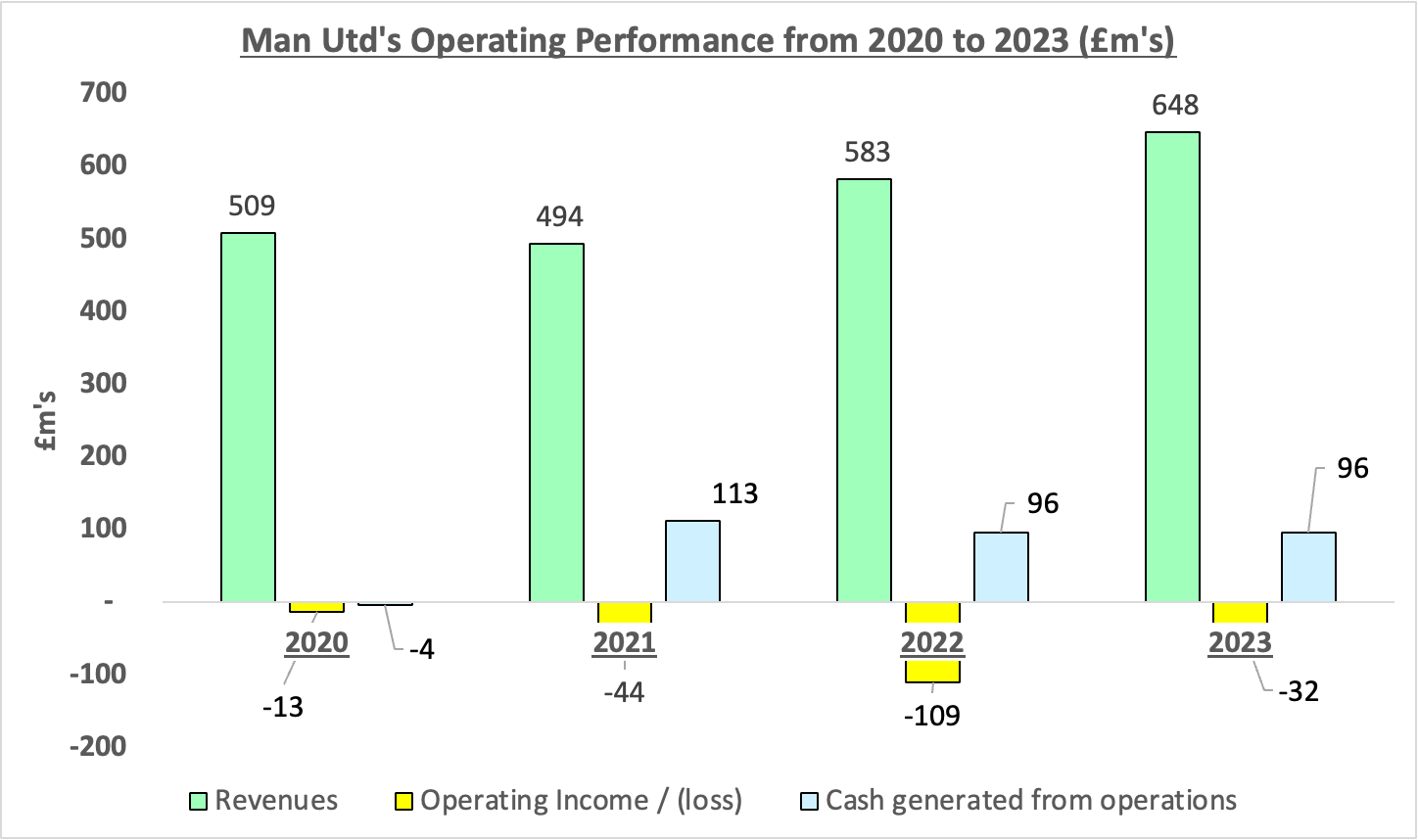
Manchester United's revenue trend from 2020 to 2023 showcases a steady climb, reflecting the club's ability to navigate the challenges of the footballing world and capitalize on growth opportunities. The figures, standing at £509 million, £494 million, £583 million, and £648 million over the respective years, underscore a positive trajectory that aligns with the club's strategic commercial objectives.
A closer look reveals that the key drivers behind the substantial revenue increase in 2023 are the categories of sponsorship and matchday revenues. These revenue streams, often influenced by strategic partnerships, sponsorships, and fan engagement initiatives, have played a pivotal role in bolstering Manchester United's overall financial performance.
Why are Manchester United Showing Losses, but Healthy Cash Generated From Operations?
Player amortization is a non-cash accounting adjustment that plays a significant role in the financial statements of football clubs like Manchester United. Amortisation, in the context of player transfers, refers to the process of spreading the cost of acquiring a player over the length of their contract. This accounting practice is used to more accurately reflect the economic benefit derived from a player over the course of their tenure with the club.
In the case of Manchester United, the club's ability to report healthy operating cash inflows, despite operating accounting losses can be attributed, in part, to the non-cash nature of player amortization. In 2023, United reported operating losses of -£32 million, but positive cash generated from operating activities of +£96 million.
Manchester United’s Diminishing Cash
As illustrated in the graph below, Manchester United’s cash has fallen from £308 million in 2019 to only £76 million in 2023.
Key cash outflows are notably tied to player investments, with significant sums allocated in 2020 (£213 million), 2021 (£99 million), and 2023 (£140 million). These investments underscore the club's commitment to enhancing its playing squad, a vital component of attempting to achieve on field success.
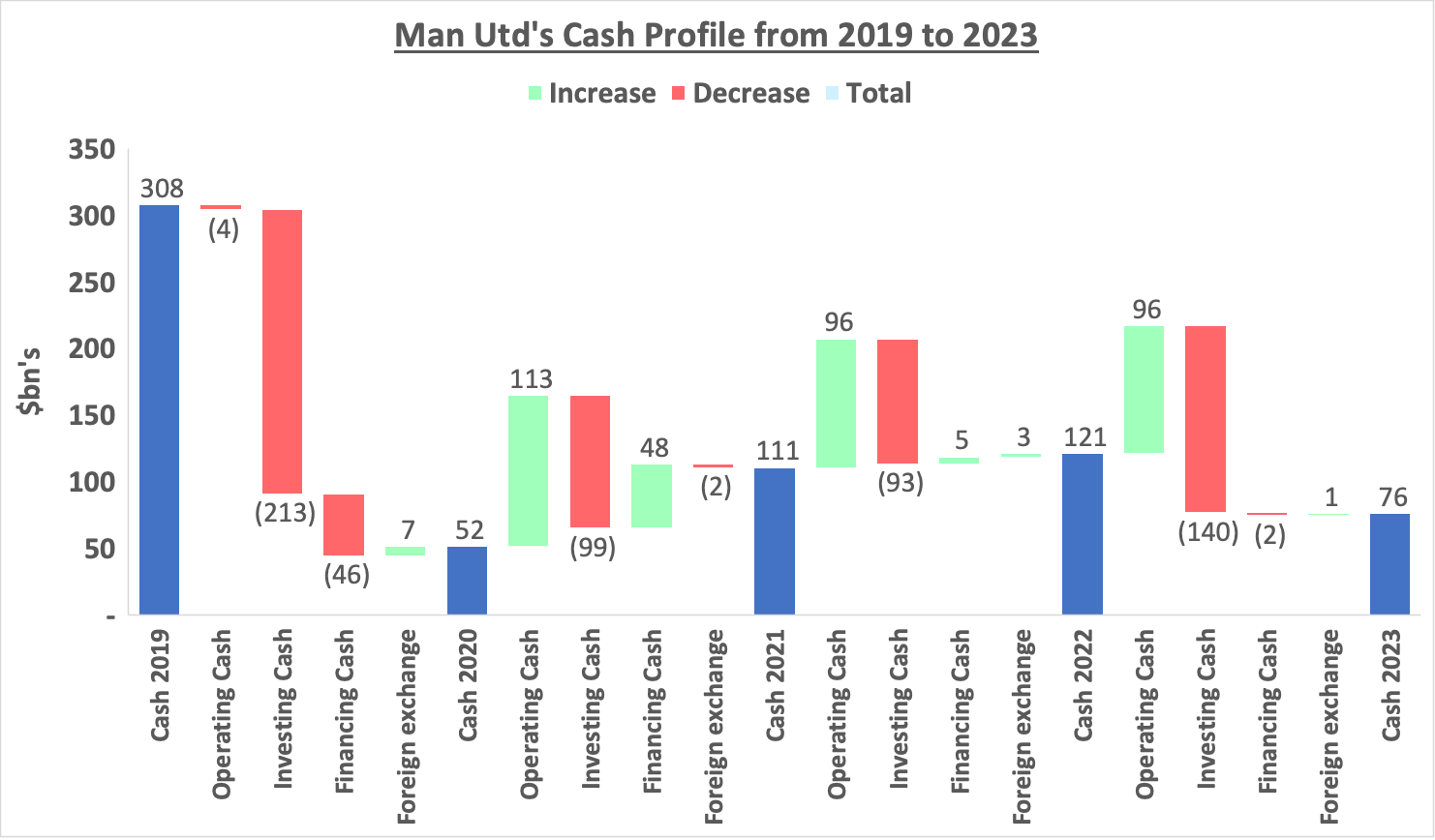
Speculatively, the apparent shortfall in cash generated from operations to cover investments could be a driving force behind Manchester United's quest for additional funding. The club may be seeking external capital to bridge the gap, allowing for continued strategic investments in player recruitment, infrastructure, and other critical areas.
Manchester United’s Debt Financing
The Accounting Equation is:
- Assets = Liabilities + Equity (i.e., funding & accumulated profits)
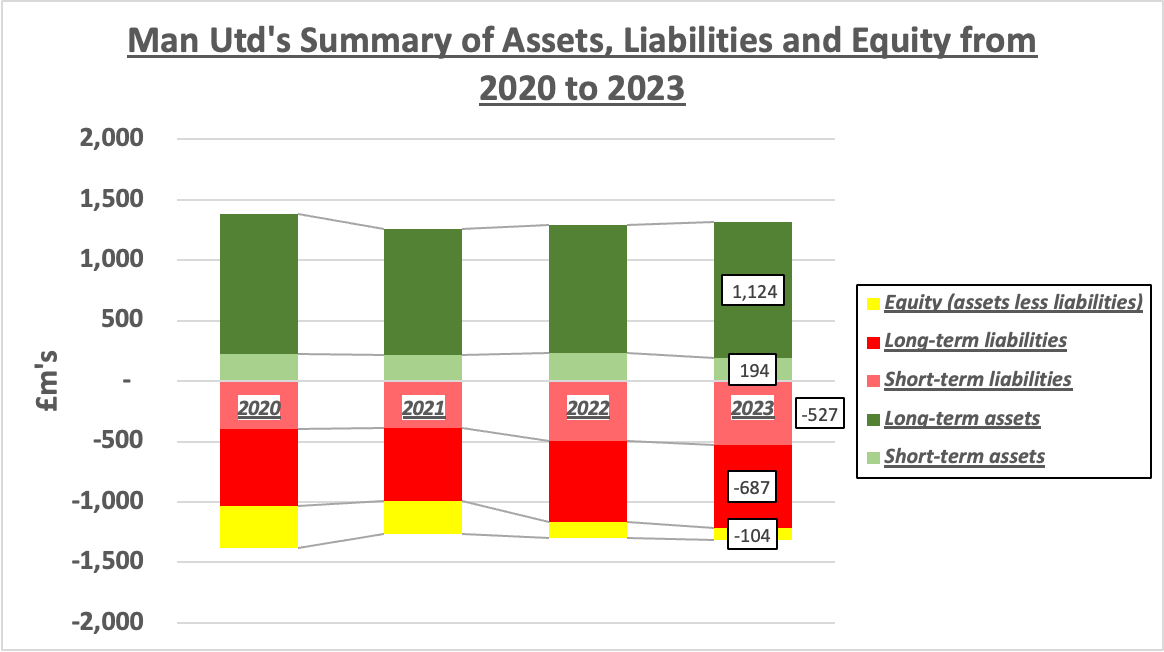
Manchester United’s accounting equation is visualised below.
The increase in Manchester United's reliance on debt finance over the past four years raises important considerations about the club's financial strategy and potential implications. While debt can be a useful tool for financing strategic initiatives and addressing immediate financial needs, an overreliance on debt can introduce several adverse impacts on a business.
Financial Gearing – What is it and Why is It Important for a Football Club?
In simple terms, the financial gearing ratio is a measure of how much a company relies on debt to finance its operations and growth. It compares a company's debt to its equity, providing insight into the proportion of funds that come from borrowed money versus those from shareholders.

Manchester United’s gearing ratio over the past four years is visualised above.
Manchester United's financial landscape undergoes a noteworthy transformation as the gearing ratio, a key indicator of the club's reliance on debt, surges from 64.3% in 2020 to 86.9% in 2023. This substantial increase in the gearing ratio signifies a growing proportion of the club's funding sourced from debt as opposed to equity.
Seeking external funding may be a strategic move to alleviate the burden of an increasingly leveraged capital structure. By attracting outside investment, Manchester United could potentially reduce its dependence on debt, addressing concerns related to interest payments, financial risk, and the overall sustainability of the current financial model.
Charting the Future: Manchester United's Financial Crossroads and the Pursuit of Sustainable Success
As we draw the curtain on our examination of Manchester United's financial playbook, a nuanced narrative of ambition, challenges, and strategic recalibration comes to the fore. Here are the key takeaways that underscore the United’s financial journey:
1) Revenue Ascendancy Amidst Challenges:
Manchester United's revenues have exhibited an upward trajectory, culminating in an 11% surge to £648 million in 2023. This financial buoyancy reflects the club's enduring global brand and revenue-generating capabilities, even in the face of on-field challenges.
2) Cash Flow Conundrum:
Despite maintaining healthy operating cash flows, there exists warning signs. The cash inflows, while robust, struggle to keep pace with the significant investments poured into fortifying the squad. This incongruence underscores the delicate balance between financial prudence and the perennial quest for on-field success.
3) Debt Dilemma and the Quest for Funding:
A worrying trend can be seen in the form of a gearing ratio soaring to 86.9% in 2023, signifying an escalating reliance on debt. This shift, accompanied by the pursuit of external funding, paints a picture of financial recalibration. The club's owners, perhaps aware of the risks associated with heightened gearing, seek a strategic lifeline to navigate the financial intricacies of football economics.
4) Navigating the Competitive Footballing Landscape:
In the backdrop of financial dynamics, the competitive landscape of modern football emerges as a formidable challenge. Returning to the top of English football poses a multifaceted challenge, demanding not only financial prowess but also strategic acumen and on-field excellence.
In this crucible of financial evolution, Manchester United stands at a crossroads. The pursuit of external funding may well serve as a catalyst for resilience and rejuvenation. As the club charts its course, the delicate dance between revenue generation, financial management, and on-field success will shape the narrative of Manchester United's future in the unforgiving arena of global football. The journey ahead is one marked by uncertainties, yet laden with opportunities for strategic resurgence and sustained excellence.